Photographing the pyramids from a balloon
You are standing in a shared compartment, into a rising sun, on a basket that rotates on its own schedule. What actually works, what to leave behind, and why the other balloons are the shot.
 By Alejandro Ramírez, Teotihuacan hot air balloon specialist and experience guide
The constraints here are unusual and nobody explains them before you are up there with fifty minutes and no second chance.
Booking choice
The shot wants first light, and the booking that protects it is the most-reviewed flight: free cancellation up to 24 hours while the weather makes up its mind.
What you are actually working with
You are standing in a compartment of a basket that may hold up to sixteen people, with a section of rail in front of you and no ability to change sides. The basket rotates slowly on its own schedule, so the composition in front of you changes without your input. You are flying into a rising sun. Both hands need to be free for the landing. And it is cold enough at 2,121 metres before dawn that your fingers are not at their best for the first twenty minutes.
That is the situation. Here is what works in it.
The practical rules
| Rule | Why |
|---|---|
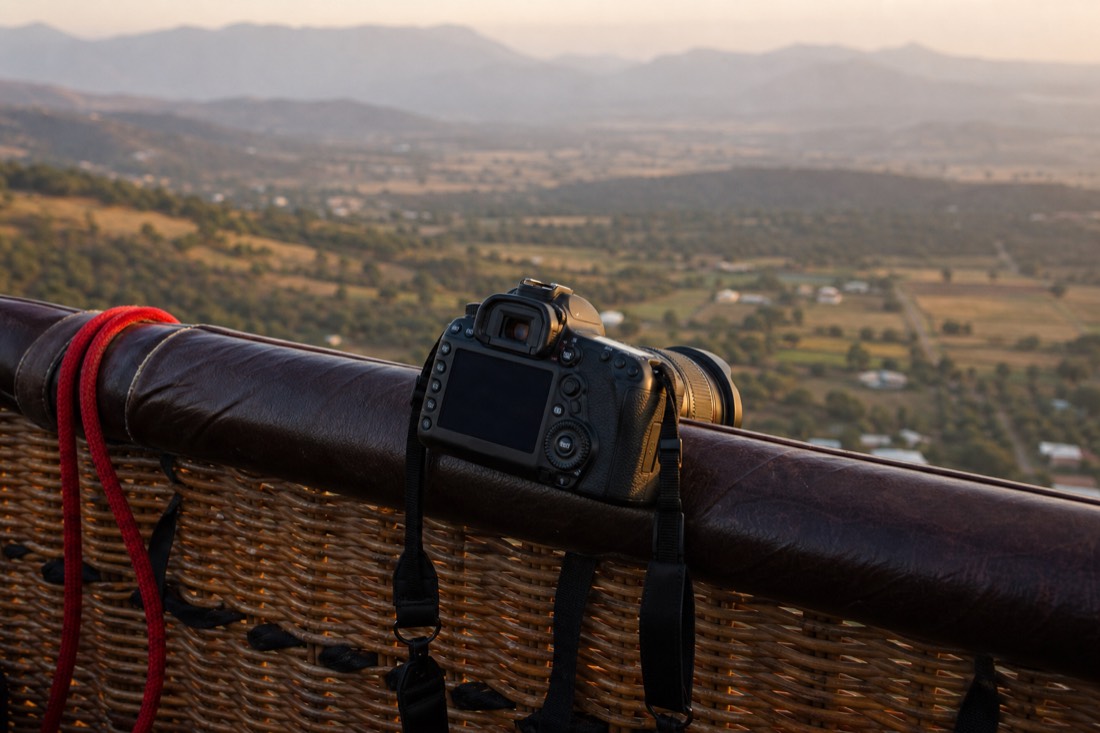
| Wrist strap on the phone, neck strap on the camera | Phones go over the side of baskets constantly and there is no retrieving one from a field |
| One camera, one lens | There is no floor space and nowhere to set anything down |
| Something around 24-70mm equivalent | Wide enough for the valley, long enough for a pyramid at middle distance |
| Shoot before you look | The light changes fast in the first fifteen minutes. Compose later |
| Let the basket rotate | Do not fight for a position. The view comes to you |
| Spare battery, inside a jacket | Cold drains batteries, and you have been awake since four |
| Shoot the other balloons | The single most reliable image of the morning |
Why the other balloons are the shot
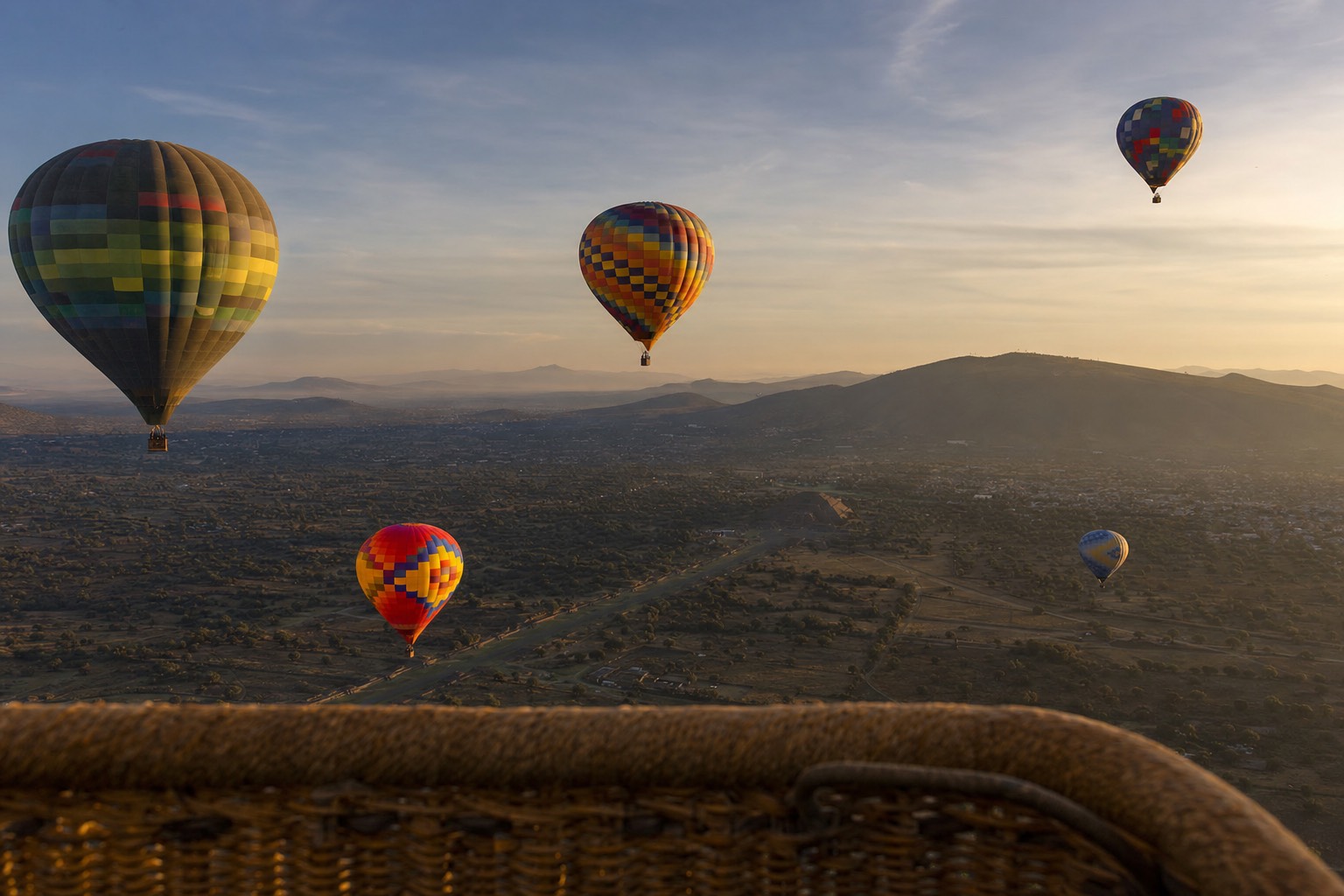
This surprises people. You go up for the pyramids and you come down with pictures of balloons.
Multiple operators launch from the same fields within minutes of each other, so within a few minutes of take-off you are in a sky full of envelopes at different heights, all catching the first direct sun while the valley below is still in shadow. A balloon low over the ground with a pyramid behind it is a cleaner, more legible photograph than a pyramid alone at that distance, and it gives you the scale reference that an aerial shot otherwise lacks.
How many balloons is a question we cannot answer, because no operator publishes a count and inventing one would be worse than saying so.
What the pyramids actually look like from up there
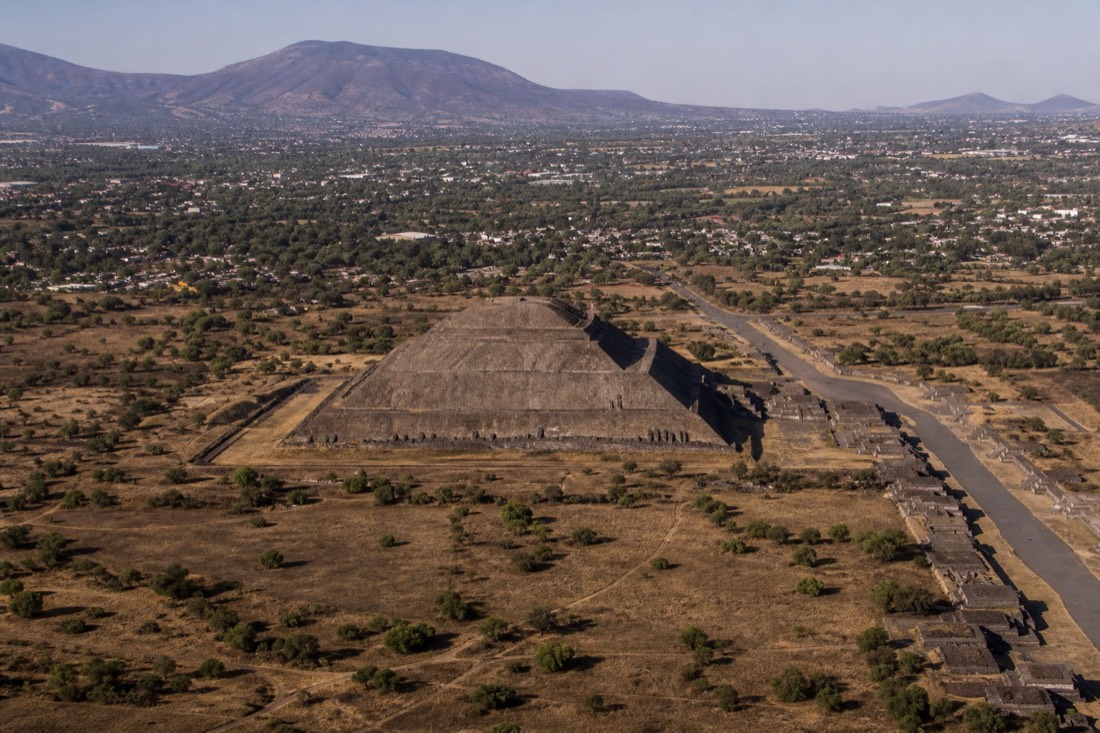
Smaller than you expect, and better lit than you expect.
Balloons do not fly directly over the zone. You are beside and around it, at whatever distance the wind decides, so the Pyramid of the Sun is a shape at middle distance rather than a wall filling the frame. What you get in exchange is the entire Avenue of the Dead as a single line, both pyramids, and the Ciudadela, all in one composition.
Photograph the composition rather than hunting for the pyramid. Low sun rakes across the terraces and every step edge throws a shadow, which is what makes the structures read as architecture rather than as mounds. An hour later that is gone.
The light window is short and it can be missed
Take-off is around 6:45, timed to first light. If wind delays the launch, the light goes. One traveller reported lifting off at 7:15 and feeling they had missed the golden hour they had booked for, which is a fair complaint and nobody's fault.
You cannot control this. What you can control is being ready in the first five minutes rather than fiddling with settings while the best light of the morning happens. Set exposure on the ground. Point at the horizon, meter for the sky, dial in a stop or so of underexposure so the sun does not blow out, and start shooting the moment you lift.
What to leave behind
- Tripod. No room, and anything braced against a moving basket is useless anyway.
- Selfie stick. Same, plus nothing should extend over the rail.
- Second lens. You will not change it. There is nowhere to put the first one.
- Camera bag. No floor space in a shared compartment.
- Drone. You are in controlled airspace with other balloons in it.
The what to wear guide covers the rest of the packing, including the hands-free rule that matters for the landing.
The one argument for a private basket
If photography is genuinely why you are booking, this is the case for paying the premium. In a private basket you move to whichever side the light is on, you shoot without shoulders in the frame, and you can ask the pilot to hold an altitude.
Volare publishes 8,500 MXN for a private flight for two against 2,610 to 2,900 MXN per person shared, so roughly triple the cheapest shared seat. For most people that is not worth it. For somebody carrying a real camera with an actual shot in mind, it is the only version that delivers.
On the ground afterwards
Do not put the camera away when you land. The deflation, the chase crew wrestling the envelope, the toast in a field at eight in the morning: that sequence is more interesting than most of what you shot in the air, and everybody is too tired to think of it.
Then, if your package includes the site, you are on the Avenue of the Dead at ten with the light still decent and the coaches not yet arrived. The ground-level view is a completely different set of pictures, and it is the half most balloon passengers rush.
Settings by stage, for a phone or a simple camera
| Launch field, pre-dawn | Low light, burner flame as the only bright point; a phone's night mode or a longer exposure on a real camera works better than flash, which the crew will ask you not to use near the fabric |
|---|---|
| First light, just after take-off | Fast-changing exposure as the sky brightens; let the camera meter for the sky rather than the dark ground below |
| Mid-flight, full daylight | Standard daylight settings; this is the forgiving window where almost any shot works |
| Landing | Put the camera away or on its strap; both hands need to be on the basket handles |
Plan your morning above Teotihuacan
Check the outing that fits your day
Initial editorial choice, not a personalized eligibility check. Confirm the operator’s full requirements before booking.
Is the shot the reason for the booking?
This screens only the details you enter. Health, pregnancy, the 220 to 308 lb balloon surcharge band, language, pickup zones and all remaining restrictions still need operator confirmation. Time allowances include check-in and travel where the listing states them.
- Balloon flight with CDMX pickup, cave breakfast and pyramids visit. The full sunrise sequence in one booking: flight, cave breakfast and the ruins walked with a guide. About 4 to 7 hours door to door; pickup between 4:20 and 5:10 a.m. Shared basket; you climb into the basket. Site entry fee is extra. Over 100 kg (220 lb) up to 120 kg costs MXN 500 more; over 120 kg up to 140 kg costs MXN 1,000 more, per the listing. Weather moves or cancels flights.
- Teotihuacan balloon flight with optional pyramids tour. The simplest way to book the flight itself, with add-ons only if you want them. 50-minute flight; half-day to full experience depending on options. The pyramids tour and transport are options, not defaults; check what your selected option includes. Operator age limits need confirming on the listing before booking young children.
- Balloon flight, La Gruta cave breakfast and guided pyramids tour. The actual La Gruta restaurant, inside a lava cave, booked as part of the morning instead of gambled on walk-up. About 8.5 hours door to door. The archaeological-site entry ticket and lunch are not included. Bookings need at least one adult. Shared basket; you climb in. Weather moves or cancels flights.
Compare your actual party totals
Enter current quotes in the same currency. “Separate spending” means costs you would actually avoid, not a day you still pay for.
Balloon flight with CDMX pickup, cave breakfast and pyramids visit
Have a travel date in mind? Check it before arranging the rest of the day. The full sunrise sequence in one booking: flight, cave breakfast and the ruins walked with a guide.
About 4 to 7 hours door to door; pickup between 4:20 and 5:10 a.m. Balloon flight, toast and flight certificate, optional underground-cave breakfast, about 1.5 hours in the archaeological zone, transport from Mexico City when selected.
Shared basket; you climb into the basket. Site entry fee is extra. Over 100 kg (220 lb) up to 120 kg costs MXN 500 more; over 120 kg up to 140 kg costs MXN 1,000 more, per the listing. Weather moves or cancels flights.
Schedule loading. You can still check dates directly on Viator below.
Scheduled dates are not confirmed seats. Select the same date on Viator to confirm availability and the final price.